Types of Stamping Operations
Stamping (also known as pressing) is the process of placing flat sheet metal in either blank or coil form into a stamping press where a tool and die surface forms the metal into a net shape. Stamping includes a variety of sheet-metal forming manufacturing processes, such as punching using a machine press or stamping press, blanking, embossing, bending, flanging, and coining.
Metal stamping is a cold forming process that uses a die and press to transform sheet metal into different shapes. Flat sheets of metal (often called blanks) are fed into a sheet metal stamping press which uses tools and die surfaces to form the metal into a new shape. Production facilities and metal manufacturers offering stamping services place the material to be stamped between the die sections and use pressure to form and shear the material into the final shape required for the product or component.
This article describes the types of stamping presses commonly used.
Types of stamping operations
Progressive die stamping
Progressive die stamping uses a series of stamping stations. Coils of metal are fed into a reciprocating press with progressive stamping dies. The die moves with the press and as the press moves downwards the die closes to stamp the metal and form the part. As the press moves upwards, the metal moves horizontally to the next station. These movements must be precisely aligned as the part is still attached to the metal bar.
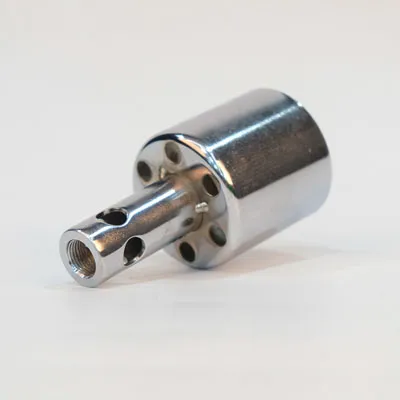
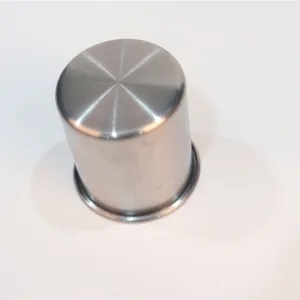
Custom Precision Deep Drawing Parts
The last station separates the newly manufactured part from the rest of the metal. Progressive die stamping is ideal for long runs as the tool can be used for a long time without damage and the process is highly repeatable. Each step in the process performs a different cutting, bending or stamping operation on the metal, thus gradually achieving the desired end product shape and design. It is also a faster process with a limited amount of wasted scrap.
Transfer die stamping
Transfer die stamping is similar to progressive die stamping, but the part is separated from the metal stroke early in the process and transferred from one stamping station to the next by another mechanical transport system, such as a conveyor belt. This process is often used for larger parts that may need to be transferred to a different press.
Four-slide stamping
Four-slide stamping is also known as multi-slide or four-way stamping. This technique is best suited to making complex components with a large number of bends or twists. It uses four sliding tools, instead of one vertical ram, to shape the part by deforming it several times. Two sliders or plungers hit the workpiece horizontally to shape it and no tooling is used. Multi-slide stamping can also have more than four moving slides.

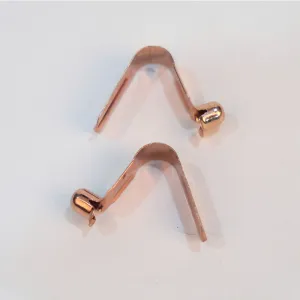
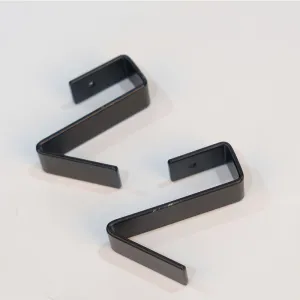
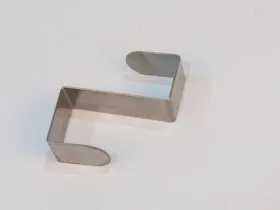
Flat Hooks
Four-slide stamping is a very versatile type of stamping, as different tools can be attached to each slide. It also has a relatively low cost and is fast to produce.
Fine blanking
Fine blanking, also known as fine edge blanking, is valuable for providing high precision and smooth edges. Usually done on hydraulic or mechanical presses, or by a combination of both, the fine blanking operation consists of three distinct movements.
Clamping the workpiece or work material in place
Performance of the elimination operation
Ejection of the finished part
Fine blanking presses operate at higher pressures than those used in conventional stamping operations, so these higher operating pressures need to be taken into account when designing tools and machinery.
The edges produced by fine blanking avoid the fractures that occur with conventional tooling and the surface flatness can exceed the edges that can be obtained with other stamping methods. As it is a cold extrusion technique, fine blanking is a single-step process, reducing the overall cost of manufacture.